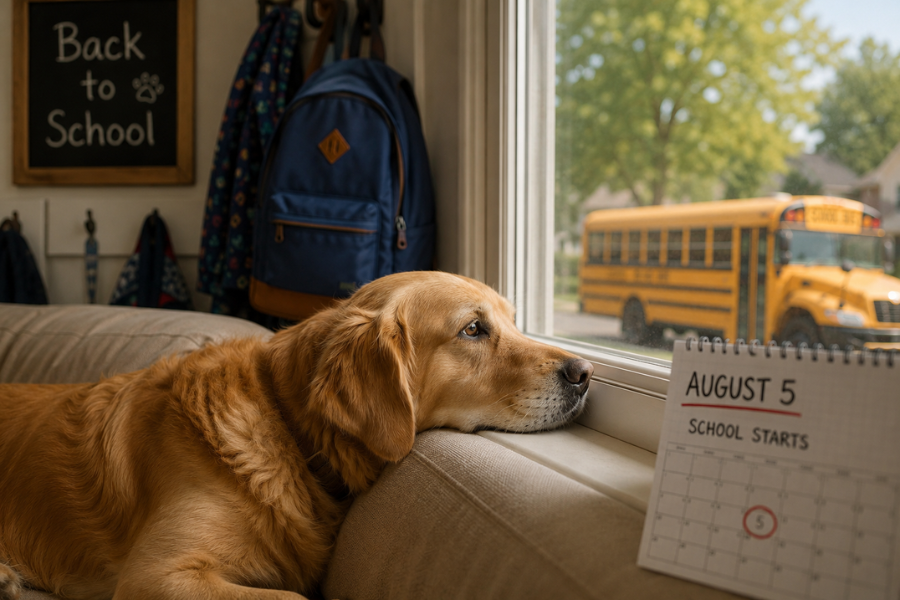
On Wednesday, August 5th, Gwinnett County schools open their doors. Buses run their routes through Snellville and Lilburn and other parts of Gwinnett County, backpacks go on, and by 8:15 in the morning your house is emptier than it’s been since May.
You’ll notice the quiet. So will your dog.
Here’s the part most pet parents miss: the problems don’t show up on day one. They show up around day ten.
Why the delay
Dogs are pattern animals. On the first day of the new schedule, your dog doesn’t know it’s a new schedule — as far as he’s concerned, everyone left the house for a while, which has happened before, and they came back, which has also happened before.
It takes roughly a week to ten days of repetition before the pattern registers as permanent. That’s when the anxiety behaviors surface. And by then, most owners have stopped connecting the behavior to the calendar. They think their dog is “acting out” or “being bad” or “regressing,” when what’s actually happening is that a dog who spent three months with constant company has just figured out that the company isn’t coming back.
What it actually looks like
Separation stress rarely announces itself. Watch for:
Housetraining regression. A dog who hasn’t had an accident in four years starts having them. This is not spite. Anxiety affects the bladder and bowels in dogs the same way it does in people.
Destruction concentrated near exits. Chewed door frames, scratched doors, shredded blinds by the front window. The location matters more than the damage — destruction at the boundary of the house is a different problem than boredom chewing on a shoe in the living room.
Vocalizing you never hear. Barking, howling, and whining that starts within twenty minutes of your departure and can run for hours. You won’t know unless a neighbor tells you or you set up a camera. Do set up a camera — it’s the single most useful diagnostic tool available to you and it costs about thirty dollars.
Refusing food while alone. A dog who won’t touch a stuffed Kong or a food puzzle all day and then eats normally the second you’re home is a stressed dog, not a picky one.
Frantic greetings. The over-the-top, whole-body, can’t-stop-spinning welcome at the door reads as devotion. Often it’s relief.
Cats, too. Cats get lumped in as low-maintenance, but a schedule change hits them as well. Watch for litter box avoidance, overgrooming to the point of bald patches, or a cat who suddenly becomes vocal in a way she never was.
What actually helps
Start before the pattern sets. Every intervention below works better as prevention than as treatment. If you’re reading this before August 5th, you have the advantage.
Break up the block of alone time. This is the highest-leverage change available. A nine-hour stretch is not the same problem as two four-hour stretches with a walk in between. The math isn’t linear — the interruption resets the dog’s clock and gives him something to anticipate.
Practice short absences. Leave for ten minutes. Come back. Leave for thirty. Come back. You’re building evidence that departures end. This is boring and it works.
Kill the goodbye ritual. The extended farewell — the baby talk, the long hug, the “I’ll be back soon, sweetie” — teaches your dog that your departure is an emotionally significant event worth being upset about. Pick up your keys, leave, don’t look back. Come home and ignore him for two full minutes before you greet him. It feels heartless. It’s one of the kindest things you can do.
Give the departure a job. A frozen stuffed Kong, a snuffle mat, or a lick mat delivered right as you walk out reframes the moment. Your leaving becomes the thing that produces the good stuff.
Front-load exercise. A dog who’s been walked before you leave is a dog with less energy available to spend on panic. A dog who’s been sniff-walked — allowed to explore at his own pace rather than route-marched — is more tired than one who did the same distance at your speed.
When it’s more than adjustment
If your dog is injuring himself trying to escape a crate or a room, breaking teeth or nails, refusing to eat for a full day, or panicking within seconds of the door closing, that’s clinical separation anxiety, not a rough transition. That needs a veterinary behaviorist, and possibly medication alongside a behavior plan. There’s no shame in it and there’s no substitute for it.
Where a midday walk fits
The reason midday dog walking books out in August in Gwinnett is that every household hits this wall on the same Wednesday.
What a walk does isn’t just physical. A professional walker arriving at a predictable time every weekday gives your dog a fixed point in the day — something to wait for instead of something to dread. The alone-time block gets cut in half. The dog gets outside, gets relieved, gets moving, and comes back to an empty house tired instead of wound up.
At 2 Paws Up, that walker is the same person every time. Not a rotating name from an app. Our walkers are background-checked W-2 employees, every visit is GPS-tracked, and you get a report with photos before your kid is off the bus. Consistency is the entire mechanism here — a different stranger every day would undo the benefit.
Serving Snellville, Lilburn, Grayson, Loganville, and parts Lawrenceville, Stone Mountain, Tucker, and Norcross since 2003. → Reserve your midday walk schedule call or text us at 770-695-3096 to talk through what your dog needs. If we’re not the right fit, we’ll tell you.
Recent Comments